How to choose your snowboard?

You will of course choose a board with a look you like, but that's not the only thing to consider!

To choose your snowboard, you will have to consider several criteria! Don't worry, Nature-Ride is here to guide you!

1. Your type of ride

The mountain offers you many different possibilities. Whether you are a powder lover, a snowpark king or a jack of all trades, you can choose a board that suits your snowboarding perfectly.

Versatile all mountain :

A classic! The most common board to discover and learn snowboarding. A board that is suitable for different terrains and riding styles. This type of board offers a great deal of freedom, allowing you to go from the slopes to the snowpark, via the powder! Particularly appreciated by beginners and intermediate riders, this is a type of board that will help you to progress in the multiple practices of snowboarding!

Freestyle jib and park :
Spending time in the air, doing crazy tricks. That's what freestyle offers!

Snowboards specially designed for freestyle have a twin-tip shape (front similar to the back)

  • More pop for easy take-off
  • Good handling 
  • possibility of landing in both directions.

Responsive and playful boards ideal for kickers, rails, boxes and half-pipe!

Freeride backcountry :
Float on a cloud with your snowboard? Taste powder fields where no one has gone before? That's what freeride offers you! Longer boards with a directional shape and a nose that is wider than the tail for perfect flotation in the powder as well as great handling on the steepest slopes! Go anywhere you want!

Splitboard :

Do you want to explore the mountain in total freedom and in a more ecological way? Splitboards allow you to climb the mountain by separating into 2 parts like a pair of skis! You will need a specific binding system and skins, but once you reach the top, you reassemble your splitboard for a 100% snowboard descent! Much less common, this practice offers a natural and ecological ride!

2. Your level

There are three levels of riders:

  • Beginner-Intermediate
  • Intermediate-Confirmed
  • Confirmed-Expert

There is often a tendency not to want to be considered a "beginner". But having an objective judgement of your level will allow you to choose the most suitable board. This will actually help you progress faster and make the experience more fun.

However, it is not uncommon to see experienced riders using beginner boards as they are very playful and allow for fun. On the other hand, the opposite is less true. A board dedicated to a "confirmed" level will be less tolerant and could therefore slow down your progress... or even put you off the practice of this discipline!

3. Your height

It is generally recommended that the snowboard reaches the chin, but you should take into account your size and type of riding.

You are rather thin: a snowboard more or less 20 cm below your height.

You're pretty strong: a snowboard more or less 17 cm below your height.

For freestyle, you should choose a smaller board! This will make it easier for you to throw your rotations and make it easier for you to link up the modules.

For freeriding, it's the opposite. A slightly bigger board will give you more lift and support on the snow.

But it's also a matter of feeling, so don't forget to do it according to your preferences!

4. Your shoe size

The size is an important element to take into account when choosing your board and not only when choosing the bindings!

With a board that is too narrow, your boots will stick out either at the toe or at the heel. In either case, you risk being hampered when taking an edge. The boots will scrape the snow and in the best case scenario you will be slowed down and off balance. In the worst case scenario, you'll fall or get hurt.
On a board that is too wide, the heels and toes will be too far apart to exert enough pressure. The leverage will be too low and you will have more difficulty initiating and maintaining a turn.

To avoid this, from size 45 onwards, you should opt for a "wide”that is to say, broader.

5. Women's board ?

It is important to know that most boards are mixed. However, there are boards specially designed for female riders!

The women's snowboards have an adapted size and width with a slightly softer flex.

6. Flex, shape and camber

You want to choose your board with even more precision? Then you can also pay attention to your board's flex, shape and camber.

The flex

Flex is the flexibility of your board. It is measured on a scale from 1 to 10

From 1 to 4: corresponds to a soft flex. Recommended for beginner riders because the softness of the board makes it more forgiving of mistakes on the slopes and easier to handle. Also popular in freestyle, this type of flex provides flexibility for tricks and landings!

From 5 to 7: corresponds to an intermediate flex. Recommended for versatile riders, it allows a good grip on the slopes but is also suitable for a taste of the snow parks!

From 8 to 10: corresponds to a rigid flex. Recommended for experienced and expert riders, it makes the board precise and responsive but also more difficult to control. It is ideal for riding on committed slopes or in freeride.

The shape

The shape is the shape of your board. There are several types.

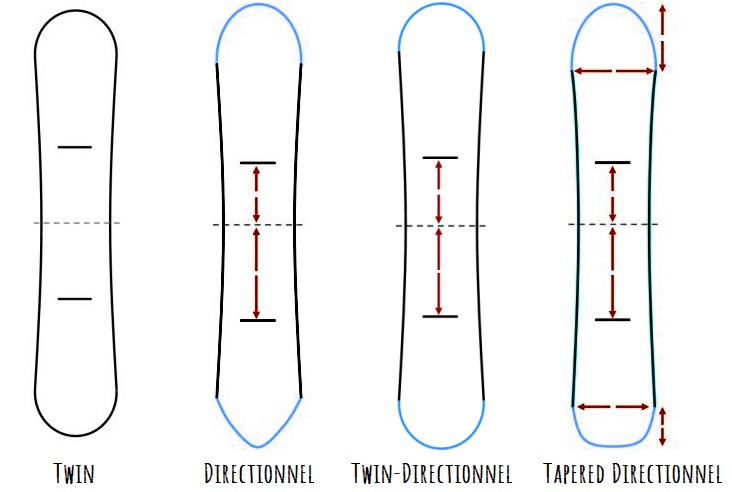
  • Shape Twin : Also known as a twin-tip, the board is perfectly symmetrical from nose to tail. The flex of the board is identical along its entire length with centered inserts and the two tips are identical. This shape is generally used for freestyle boards.
  • Directional Shape :  the board is not symmetrical. The nose of the board is longer than the tail for a better grip on and off the track because the centre of gravity is moved to the back of the board. The nose can also be wider than the tail.
    Ideal for fun freeride sessions!
  • Shape Twin-Directional : It is a compromise between the Twin shape and the Directional shape. The inserts are slightly set back, which offers a good behaviour on the powder + its symmetrical shape offers a better control for freestyle. A shape for the versatile rider who switches from freeride to freestyle.
  • Shape Tapered Directional : Designed as a directional shape except that the nose is wider than the tail. This makes the snowboard much more manoeuvrable in powder because the nose stays on the surface of the snow. This is the perfect shape for pow-pow enthusiasts!

The camber

The camber of a snowboard is its profile. It determines the parts of the board that will be in contact with the snow.
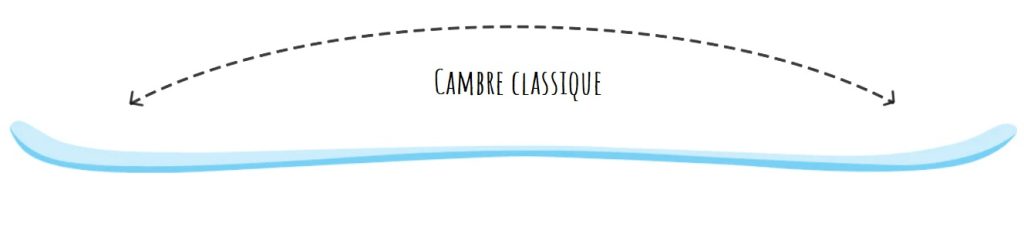
  • Classic camber: Also called positive camber and described as the universal camber. It has two points of contact with the snow at the tips. The centre of the board does not touch the ground.
    The positive camber acts like a spring, which puts pressure on the board when it goes against its natural shape, so it will want to return to its original shape which will produce a force that will improve your pop.
    The classic camber will also provide grip and precision. Ideal for both beginners and advanced riders!
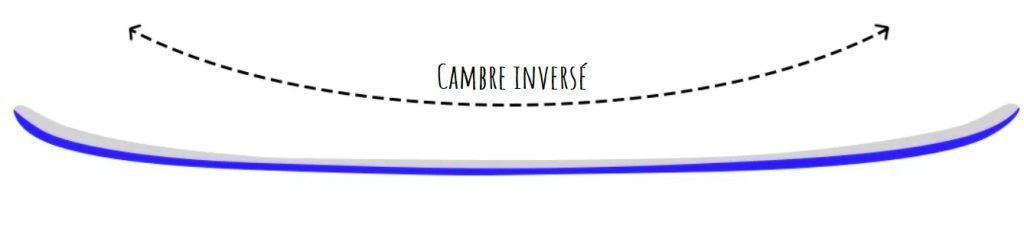
  • Inverted camber : Also called rocker, it is the opposite of the positive camber. It is banana or V-shaped.
    The advantage of the inverted camber is that it has only one point of contact with the snow, which makes the board very manoeuvrable, very playful and tolerant of small mistakes. It also provides great flotation on powder!
    Ideal for learning snowboarding and improving your freestyle skills.
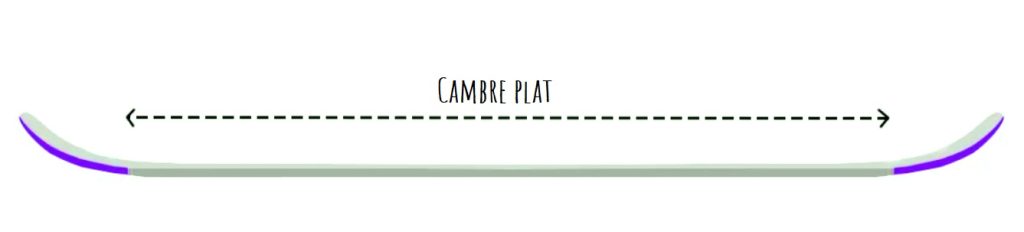
  • Flat camber : Also known as zero camber, the board is totally flat from nose to tail as its name suggests. The base of the board is in full contact with the snow, which gives perfect grip and stability on the snowpark modules while keeping the pop. The flat camber can have a raised tip for buoyancy in the powder.
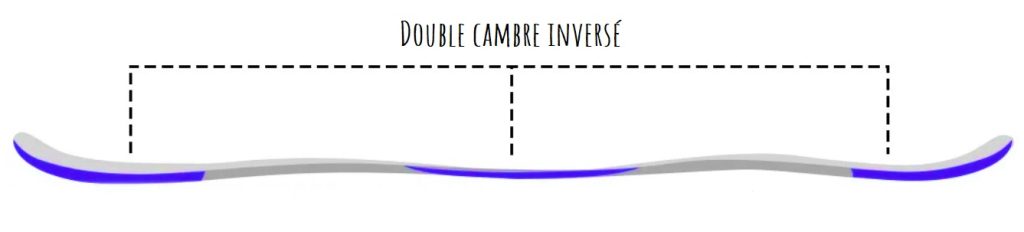
  • Double inverted camber: Also known as the W Rocker or hybrid rocker, this W-shaped camber retains the benefits of the inverted camber while increasing the number of points of contact with the snow. It represents a combination of two inverted cambers on the same board. The main contact point remains the centre of the board with two new contact points in the tips.
    We keep the advantages of the inverted camber: manoeuvrability, buoyancy and tolerance with the addition of stability and grip.
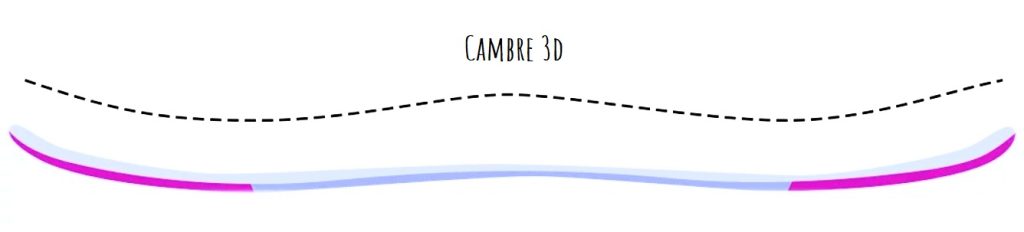
  • 3D camber : Here, only the centre of the board is flat and the sides are slightly raised to allow for good buoyancy. The edges are raised to reduce unintentional hooking for better turn entry. It also allows for great agility in turns and snowparks.
Now you have all the information you need to choose your snowboard, but don't forget to take your feelings into account!

GOOD RIDE !